

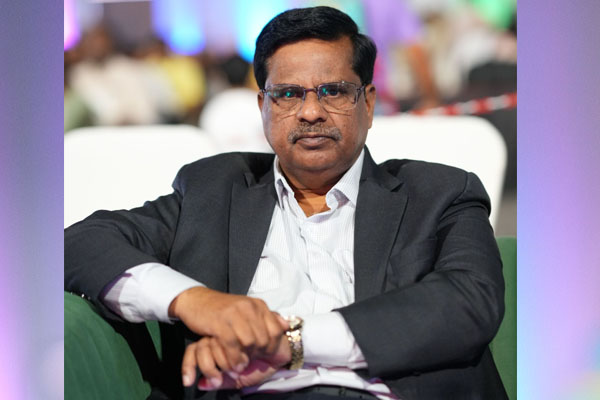
1. Could you briefly introduce about yourself and highlight contributions to international Aero Space law, and higher education in India?”
A) Myself, Prof. (Dr.) V. Balakista Reddy, Professor of Law and Chairman, Telangana Council of Higher Education (TGCHE), is a distinguished scholar of International Aerospace Law with over two and a half decades of teaching, research, and academic leadership. Holding an L.L.M from Osmania University and an M.Phil and Ph.D in International Air and Space Law from Jawahar Lal Nehru University (JNU, New Delhi). I led pioneering centres in Aerospace and Defence Laws, was closely associated with ISRO in drafting model space legislation. A recipient of the Telangana State Meritorious Teachers Award (2017) and NALSAR’s Excellence in Research Award (2021).
2. Could you tell us about your academic contributions in the field of Aerospace and Defence Laws?
A) “As Director of the Centre for Aerospace and Defence Laws (CADL), I introduced a range of value-added academic programmes in Aviation, Space, Defence and Maritime Laws. These include the Master’s programmes in Aviation Law and Air Transport Management (MALATM), Security and Defence Laws (MSDL), Space and Telecommunication Laws (MSTL), and Maritime Laws, as well as Post-Graduate Diplomas in Aviation Law and Air Transport Management (PGDALATM), GIS and Remote Sensing Laws (PGD-GISRSL), and Advanced Maritime Laws (PGD-AML). These programmes were designed to address the rapidly growing needs of India’s aerospace, defence, telecommunications and maritime sectors, which require a large pool of skilled legal and managerial professionals to support the expansion of airports, airlines, aerospace industries, defence establishments and maritime infrastructure.”
3. “Could you highlight your scholarly contributions, including as Editor-in-Chief of leading law journals and major publications in air, space, defence and technology law?”
A) I was editor in chief of the Indian Journal of Air and Space Law, Indian Journal of Defence and Maritime Laws, M.K. Nambyar SAARC Law Journal, the Mahindra Journal of Law & Technology and currently Editor in chief of Telangana Journal of Higher Education. My major publications include Air Law and Policy in India (1994), Recent Trends in International Space Law and Policy (1997), Emerging Trends in Air and Space Law (2007), Space Law and Contemporary Issues (2012), and Aviation and Space Industry: Future of Transport (2023), A compendium on Civil Aviation Regulations in India (2025).
4. What are the Key Highlights of the BlueBird Block-2 satellite Mission ?
A) The successful launch of BlueBird Block-2 on 24 December 2025 from Sriharikota marks a historic milestone for India’s space sector. This mission is not merely a technological success; it represents a major strategic, commercial, and legal breakthrough for India. The LVM3-M6 (‘Bahubali’) has placed one of the world’s heaviest and most advanced commercial communication satellites into orbit, demonstrating India’s capability in high-value commercial launches. The mission symbolizes India’s transition from a government-led space programme to a globally competitive space economy, supported by a structured regulatory ecosystem involving NSIL, Antrix Corporation, and IN-SPACe.”
5. What is the Breakthrough Connectivity Technology ?
A) “BlueBird Block-2, developed by AST SpaceMobile (USA), is designed to deliver broadband cellular connectivity directly to ordinary smartphones from space, without requiring ground towers or specialized satellite phones. The satellite carries a massive phased-array antenna of about 223 square metres—one of the largest ever deployed in orbit. This enables 4G and 5G voice, data, messaging and video services to standard mobile phones anywhere on Earth, including remote, rural and disaster-affected regions. It represents a revolutionary shift in global telecommunications by integrating satellites directly into terrestrial mobile networks.”
6. How is Commercialisation and Privatisation of India’s Space Sector Evolving?
A) “India’s space programme is undergoing a structural transformation from a government-dominated model to a mixed ecosystem with strong private sector participation. Commercial activities in space now span satellite communications, Earth observation, broadcasting, navigation, space research and emerging fields such as space tourism. Institutions such as Antrix Corporation, NewSpace India Limited (NSIL) and IN-SPACe are enabling private industry to access ISRO’s infrastructure, technologies and launch services. This shift reflects India’s commitment to creating a globally competitive, innovation-driven space economy.”Further, the institutions like Antrix corporation, New Space India Limited (NSIL) and Indian National Space Promotional & Authorization Centre (IN-SPACe.)” also promoting commercialization and privatization of space activities in India.
7. How is India’s Commercial Space Leadership growing ?
A) “The BlueBird Block-2 mission was executed under a commercial launch agreement between NewSpace India Limited (NSIL), ISRO’s commercial arm, and AST SpaceMobile of the United States. It represents a significant endorsement of India’s heavy-lift launch capability by a leading global satellite operator. This success strengthens India’s position as a reliable and cost-effective launch service provider, enhancing its standing in the international commercial space market.”
8. What are the Economic Benefits by this Mission to India ?
A) “Such international commercial launch contracts generate valuable foreign exchange earnings for India and contribute directly to the growth of the domestic space economy. The mission boosts confidence in India’s launch infrastructure, attracting future investments, joint ventures and repeat customers from global satellite companies. It also supports the development of high-technology jobs, advanced manufacturing and downstream space-based services.”
9. What are the Legal and Policy Implications for India?
A) “This mission reinforces India’s emergence as a serious player in the international commercial space market. As private and foreign satellites increasingly use Indian launch services, India must strengthen its legal and regulatory framework governing authorization, safety, liability, registration and dispute resolution. Existing laws relating to contracts, property rights, intellectual property, insurance and liability need to be aligned with space activities. While private satellite operations are now permitted, India still requires a comprehensive space law to clearly define the responsibilities of operators and the Government in the event of damage or accidents, in conformity with international space treaties.”
10. Why is the BlueBird-6 launch such a major achievement for India?
A) This mission marks India’s entry into the elite global league of heavy commercial satellite launch providers. For the first time, a large U.S. commercial telecom satellite has been launched by India’s LVM3 rocket. This shows that India is no longer only a scientific space power, but a trusted global commercial launch hub.
11. What exactly does the BlueBird-6 satellite do?
A) BlueBird-6 enables direct satellite-to-mobile communication. Ordinary smartphones—without any special hardware—can connect directly to the satellite. This means people in mountains, deserts, oceans, and disaster-hit areas can get mobile connectivity even where no towers exist.
12. Why did a U.S. company choose ISRO instead of other global launch providers?
A) Because ISRO offers unmatched reliability, cost-effectiveness, and precision. The LVM3 has already proven itself with Chandrayaan, OneWeb and Gaganyaan missions. Choosing ISRO reflects global confidence in Indian technology.
13. How does this mission help India commercially?
A) This is a paid international commercial launch through NewSpace India Limited (NSIL). It brings foreign revenue, supports India’s space economy, and positions India as a major exporter of space launch services—similar to aviation or software exports.
14. Does India own the BlueBird satellite?
A) No. The satellite belongs to the U.S. company AST SpaceMobile. But India owns the rocket, the launch system, and the spaceport, and we are legally recognized as a launching State under international space law. This gives India strong strategic and legal standing in global space governance.
15. What is India’s legal responsibility in this mission?
A) Under UN space treaties, India is responsible for the safe and compliant launch. By successfully launching this advanced satellite, India has demonstrated that it is a responsible and trusted space power, fully compliant with international law.
16. How does this strengthen India–USA relations?
A) This mission reflects deep strategic trust between India and the United States. Space is now a high-technology and geopolitical domain, and America entrusting India with such a critical satellite shows India’s rising global stature.
17. Will this technology benefit India directly?
A) Yes. This technology can be extended to:
• Border areas
• Disaster management
• Remote villages
• Maritime and aviation sectors
India gains both strategic insight and technological exposure to next-generation satellite communications.
18. How does this mission support Digital India and Viksit Bharat @2047?
A) This is exactly what Viksit Bharat @2047 stands for—India building and exporting global digital infrastructure. Satellites like BlueBird-6 will help connect the unconnected, support education, healthcare and governance from space.
19. What message does this send to Indian students and universities?
A) It sends a powerful message: The future belongs to those who master space, AI, telecom, data, and space law. Indian youth are no longer job-seekers; they are becoming global technology creators. Telangana universities must now align with these frontier technologies.
20 . Is this mission a one-time event?
A) No. This is the beginning of a new commercial era. Many more foreign satellites and constellations will now choose India. ISRO’s LVM3 is now globally recognized as a commercial heavy-lift launcher.
21 . What is the single most important takeaway for India?
A) India has moved from being a space participant to a space service provider for the world. We are now building, launching, and enabling the global digital future—from Indian soil.